Memory / Essay / September 11, 2026
The People Who Hold Things Together
Remembering Father Mychal Judge, Twenty-Five Years Later
I began writing this expecting it to be a remembrance of September 11, twenty-five years later. I thought I knew what the story would be. Instead, it became a two-day journey into a past I had not intended to revisit and a story I had not intended to tell.
The historical record requires the full name: Father Mychal Judge. To the people who knew him, he was simply Father Mychal.
Speak to almost any longtime member of the New York Fire Department and say those two words and there is little need to explain whom you mean. September 11 gave him a place in history, a number—Victim 0001—and one of the most enduring photographs of that day. But none of those things are how I first knew him.

I remember his smile. I remember him in shorts and sandals at Idylease, and at Rockefeller Center on Christmas Eve leading carols. I remember his eyes fixed intently on me one evening in the Oak Room of the Plaza Hotel, listening to me talk about things I did not think were particularly important.
Somehow, he had heard something else.
My father, Dr. Arthur Zampella, was the police surgeon in West Milford, New Jersey. Father Mychal was the fire chaplain. When there was a fatal accident, my father might be called to make the official pronouncement while Father Mychal administered the last rites.
I was a boy, and sometimes my father left me waiting in the car while he went beyond the police line. Father Mychal often stood at the periphery until he was needed. If he saw me sitting there, he would come over, lean into the window and keep me company.
He had a way of making the abnormal normal, and part of it was humor.
It could be dark humor. I remember standing with him outside a police line once while everyone waited for the funeral director, who was late. I cannot remember Father Mychal’s exact words, but the substance has stayed with me: at the rate the man was going, he would probably be late to his own funeral, and somebody needed to get the show on the road.
The police laughed. He was not making light of the dead. He was relieving the living.
My father was more serious by temperament, and sometimes Father Mychal would needle him when the gravity became too much.
“This isn’t a Dickens novel,” he would say. “There has to be relief somewhere in this.”
My father would smile.
As a child I sometimes thought Father Mychal was irreverent. I never thought he crossed a line. He was simply unpredictable, the local priest who did not always behave the way people expected a local priest to behave.
He liked attention. There was vanity in him, and I think he was amused by it. He had the gift of the Irish gab and knew how to make an entrance, but he did not take himself as seriously as people looking back on him might imagine. He understood the difference between enjoying attention and making something about himself.
One summer my family’s theater company, Shoestring Productions, staged The Sound of Music. Shoestring had grown out of a very serious moment in West Milford, when a number of young people in the community had died by suicide. My father and others were trying to give young people something to belong to, somewhere to put their energy, something that might strengthen the community.
We wanted Father Mychal to make a cameo in the wedding scene as the Archbishop of Austria. At first he resisted. I think he worried it might be grandstanding. Eventually he agreed, and once he agreed, he did it properly.
He arrived shortly before his scene wearing shorts and sandals, then changed into the finest vestments he could obtain. He walked onto the stage, stood before the von Trapps and raised his hand to marry them.
The audience immediately recognized him and applauded.
Father Mychal understood the desired effect.
When his part was finished, he changed and slipped out the stage door. He did not stay for the curtain call.
That would have been too much.
Father Mychal came to Idylease often. He did not need an invitation and usually did not need a particular reason. He liked being where things were happening, at the center of activity.
There might be patients coming and going from my father’s office. In summer we might be constructing sets on the porch. There were always people around.
Father Mychal would watch for a while, talk to whoever happened to be there, then wander down to my father’s office and spend some time talking with him.
Sometimes those conversations were about local problems and how they might marshal people or resources to do something about them. My father and Father Mychal approached their vocations differently, but I think they understood one another.
One administered to the body and the other to the soul.
Father Mychal was a man of great warmth. People gravitated toward him. He was also aware that not everybody loved him.
In West Milford, there were things about Father Mychal that people discussed in hushed tones, and some people could be unkind in their judgments. I did not personally witness the worst of it, but I knew it existed, and Father Mychal certainly knew it too.
He did not seem to become bitter.
When my father died in January 1992, I called Father Mychal at his parish in New York and waited while someone found him.
When he came to the telephone, I identified myself and said:
“My father is dead.”
There was a pause.
“When do you want me there?”
He did not ask for an explanation.
He came.
At the funeral he was completely at ease with grief. He could move through a room naturally, speak to people and use humor when it was needed.
At one point he told the congregation that he had been informed by the bishop that he was not permitted to return to the parish. Then he explained that the bishop had died the night before.
Father Mychal stood over my father’s flag-draped casket, looked upward, extended his arms and shrugged.
“God works in mysterious ways.”
The congregation laughed.
“Arthur would have appreciated that story.”
He was right.
Years earlier, at accident scenes, Father Mychal had used humor to make unbearable circumstances momentarily survivable. At my father’s funeral he did the same thing for us.
His humor was not shtick. He understood the moment in front of him.
New York suited Father Mychal. It did not make him more confident; he had never lacked confidence. It seemed to make him more at ease. West Milford had been a small place in which a man like Father Mychal could become very visible very quickly.
New York gave him a bigger canvas to paint on.
His ministry widened with it: AIDS patients, firefighters, police officers, families in grief, the families of TWA Flight 800, people celebrated and people forgotten.
He went where he was needed.
During the AIDS crisis, Father Mychal spent time with men who were dying of the disease. He told me that he had been instructed to wear hazmat suits and face shields when he went near them. He refused.
Once, while speaking with me about it, he said something I have never forgotten:
“How can I let a barrier come between these men and God?”
Among the people who became part of his life was Detective Steven McDonald.
McDonald was an NYPD officer who had been shot and paralyzed while on patrol in Central Park in 1986. He later became widely known for forgiving the teenager who shot him.
Several months before September 11, Father Mychal and I crossed paths again.
By then I was working at the Plaza Hotel. I had been fascinated by the Plaza since I was sixteen, when my father offered to take me anywhere in New York for my birthday and I chose afternoon tea in the Palm Court. At sixteen the place seemed enormous to me—the silver, the china, the crystal, the uniforms and white gloves, the quiet precision with which people moved through the room.
Years later I was working inside it.

The General Manager, Gary Schweikert, had once told me that as a boy in New Jersey he had been an altar boy for Father Mychal. I have sometimes wondered whether Gary ever spoke to him about me.
I will never know.
One evening I was standing at the maître d’ desk in the Oak Room when I looked down the long mosaic hallway extending along the lobby and saw a Franciscan friar pushing a wheelchair.
At first I noticed the habit and the knotted rope belt. Then I noticed the respirator hoses wrapping around the back of the wheelchair and the labor involved in every breath.
It was Steven McDonald.
I greeted him by name and asked whether they were joining us for dinner.
Then I looked at the friar.
Father Mychal.
He did not recognize me. It had been years, and there was no reason he should have expected to find me standing behind the maître d’ desk in the Oak Room of the Plaza Hotel.
I did not tell him who I was. Instead, I removed the brass nameplate from my breast pocket, stepped from behind the desk and pressed it into his hand.
He looked down, then back at me.
“Oh my God.”
For a moment he seemed dumbfounded. Steven did not understand what had just happened, so Father Mychal explained:
“I shared quite the history with this young man and his father many years ago.”
I seated them at a table toward the rear of the Oak Room, away from the foot traffic.
The Plaza was a union hotel, so managers did not ordinarily perform the work of the service staff. I told the waiter assigned to the table that I intended to take care of them myself.
He did not object. He extended me that courtesy.
I selected the wines, filleted Dover sole tableside and carved prime rib from the sterling silver service cart.
Steven’s physical condition made eating difficult. Father Mychal and Steven’s wife cut his food and helped feed him.
At some point I sensed that Steven was uncomfortable with the attention being directed toward the table. The carpet was being rolled out for him, and I think he knew it. Nothing was said.
Father Mychal seemed to read it too.
Later Father Mychal and I stepped away from the table.
He was beaming.
“How?” he asked. “How is it that you are here?”
I told him what I could about the years in between, how I had ended up in New York and how I had arrived at the Plaza. The conversation, as I remember it, was mostly polite catch-up. I was not confessing anything or knowingly revealing some unhappiness in my life.
I remember thinking I was talking about nothing.
But he listened.
What I remember most clearly is the sustained eye contact. His attention never wandered. Whatever he was hearing, it was more than I understood myself to be saying.
Somewhere in that conversation we touched on West Milford. Neither of us needed to explain what sat beneath the name. As I remember it, Father Mychal alluded to being on the correct side of the Hudson.
He had found where he belonged.
While we were talking, Steven began to cough. We returned to the table immediately. He was having difficulty swallowing. Father Mychal took a napkin, sat beside him and seemed to know exactly what to do. He attended to him calmly until the moment passed.
Then the evening continued.
I had asked the kitchen to prepare a birthday cake for Steven. I lit the candles and brought it to the table.
What I remember most is the glow of those candles on everyone’s faces.
Steven could not blow them out himself. Father Mychal and Steven’s wife stood beside him.
“Make a wish, Steven.”
Then the two of them leaned forward and blew out the candles for him.
At the end of the evening Father Mychal thanked me, then said:
“I saw what you did here tonight.”
I knew what he meant. I had tried to be felicitous—to understand the circumstances, anticipate what was needed and allow Steven to enjoy the evening without making his limitations the center of it.
Father Mychal had noticed.
A few days later a secretary came to me with an envelope.
“This is for you,” she said. “It is not addressed correctly, so I wanted to make sure you got it.”
THE OAK ROOM
THE PLAZA HOTEL
MANHATTAN
By ordinary postal logic it probably never should have reached me.
It was from Father Mychal.
He wrote:
“It was unbelievable that we should once again meet. The more I think of it, the more I think that your dad must have just willed our meeting by placing us together after all these years, for he was a great planner and idolized his boy!! And you know what I think? I can see change in you. I know it's hard on you and you are being challenged. See what God wants to do for you. He does have a plan for you. I know you are unsure of that plan, but you must believe this. It will be revealed to you in time.”
He suggested that we have lunch and catch up.
We never did.
What stayed with me was not his suggestion that my father might somehow have arranged our meeting. I have always regarded that as a lovely sentiment.
It was the line:
I can see change in you.
How did he know?
I had not told him I was changing because I had not recognized it myself. From my perspective, I had stood in the Oak Room and talked about nothing.
Father Mychal had apparently heard something else.
There was a gentleness in the way he wrote about it. I did not read it as a charge or a prophecy. He was not telling me what to do. It felt more like an invitation to remain open to the possibility that the life I could see in front of me might not be the only one available.
See what God wants to do for you.
A few weeks later, a Vice President of Sheraton Hotels told me to apply for a Food & Beverage Manager position at the Essex House, two levels above the position I held.
I protested.
“Just do what I am asking and then you will see.”
I applied and got the job.
At the time I made no connection between that and Father Mychal’s letter. I believed I had earned the position through my work and through a normal application process.
I still believe that.
If another path was beginning to open, I could not yet see it.
Father Mychal had simply suggested that I remain open to the possibility.
On the morning of September 11, 2001, I was standing on the Jersey City waterfront when the first tower began to collapse. I had a camera in my hands and raised it at precisely the moment the building started coming down.
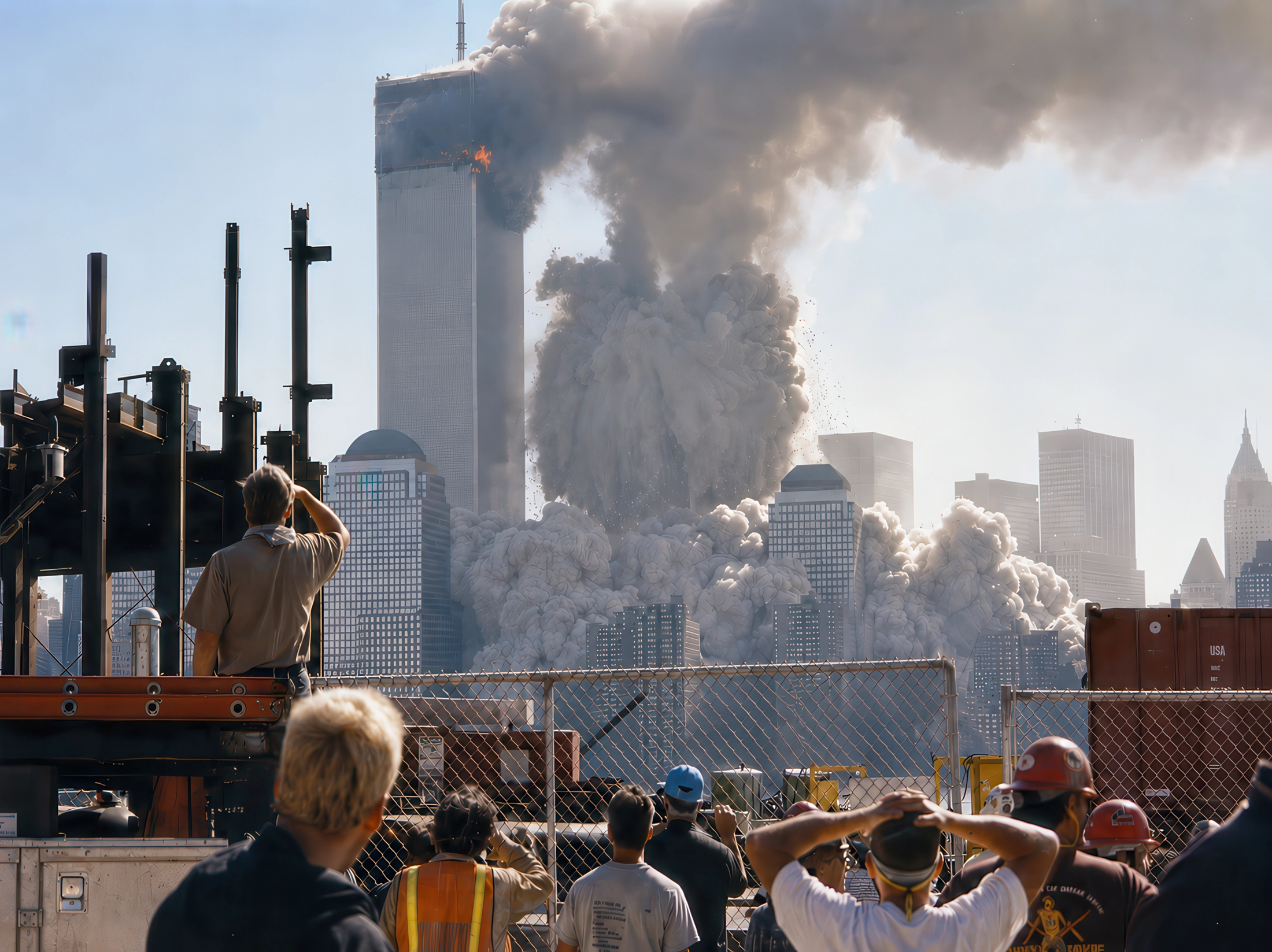
What I remember most strangely is the sound.
From across the river, with the wind carrying much of the noise away from us, the visual catastrophe did not match what reached my ears. There was only a low rumble.
Nearby were steelworkers, some of whom had worked on the original World Trade Center. Before the collapse they had been studying the buildings, debating whether they would hold.
Then one of them did not.
Everyone around me wore the same grave expression.
That night I put on my Army Reserve uniform and tried to find some way across the Hudson to help. I identified myself to a New Jersey State Trooper and told him exactly what my status was:
“I am an Army reservist. My unit has not been activated at this time, but I would like to cross the river to Ground Zero.”
He looked the other way as I made it onto a tugboat, but the harbor was closed. Eventually I learned that the PATH was still operating into Manhattan.
I crossed and walked downtown in combat boots, trying to get through the perimeter.
The State Police stopped me.
“Show me orders.”
I had none.
“Go home.”
I tried another crossing, then another. The answer was the same.
Eventually I walked back uptown.
What stayed with me was the uncertainty of that night. Nobody seemed to know very much. People stood around radios trying to understand what had happened, what was still happening and what might happen next.
The following day I returned to work at the Rainbow Room.
One couple came for dinner. We would have served them, but eventually they left.
The staff changed out of uniform, sat together in the dining room in our street clothes and stared downtown at the pile.
Nobody said anything.
There was nothing to say.
For weeks afterward the smell hung over lower Manhattan. For nearly a year, whenever I came out of the subway, I would instinctively look for the towers to orient myself.
Eventually I stopped.
I think that was acceptance.
I did not publish the photographs I had taken that morning for fourteen years.
For a long time I was not sure they should be seen. I did not want to make something out of what I had witnessed or have the photographs feel like an exploitation of it.
In 2015, on the fourteenth anniversary of September 11, I finally assembled them into a photo essay. CNN selected it as an Editor’s Pick.
Fourteen years had passed before I was ready to let the photographs become part of the record.
New York did not feel the same for a long time. I am not sure it ever became quite the same city for me again.
Two months after September 11, American Airlines Flight 587 went down in the Rockaways. I was on a PATH train at 14th Street when word spread that another airplane had crashed.
Nobody yet knew what it meant, and in those days uncertainty alone was enough.
When the train was finally ready to leave, people surged into the cars. I was pushed against the side of one as others became caught in the doors.
At the next station the crowding eased.
Then nobody spoke.
A car could backfire in those days and people would flinch.
You rolled with uncertainty.
For me, that was not something September 11 had created. Life could change without warning. You absorbed what had happened, regained your footing and did what came next.
I could allow fear to organize my life or continue living it.
I chose to continue.
Father Mychal remained in my thoughts from time to time, but he did not govern the decisions I made afterward. My decisions were my own. His presence in my life was different. It remained in memory, in the letter and eventually in the footage.
When I later watched the Naudet brothers’ documentary about September 11, I saw Father Mychal in footage they had captured inside the North Tower lobby that morning.
I had never seen that expression on his face before.
He looked deeply concerned. He stood near the elevator banks, his eyes closed, his lips moving in prayer.
There was no humor in him, but that did not make him a different man. At an accident scene, humor might relieve the living. At my father’s funeral, a joke might allow grieving people to breathe.
September 11 required something else.
The moment was immense, and he was grave.
I had been standing across the Hudson while the same event unfolded. In an odd way we were experiencing the same catastrophe at the same time, but I was a spectator.
He was at the center of it.
Even now, I find it incomprehensible to imagine what might have been going through his mind. I do not presume to know. I believe he was praying for others. The firefighters around him were his boys.
Father Mychal had a prayer he was known to say:
“Lord, take me where you want me to go; let me meet who you want me to meet; tell me what you want me to say; and keep me out of your way.”
I knew that prayer while he was alive. After his death, those words acquired another weight.
I do not know what prayer he was saying in the North Tower lobby. I know only that what I saw seemed consistent with the man I had known.
After the South Tower collapsed, Father Mychal was fatally injured inside the North Tower lobby. Firefighters and others carried him from the building, and the photograph of them carrying him became one of the defining images of September 11.
When I first saw it, I felt utter sadness.
He was not smiling.
I always remembered him smiling.

When the photograph appeared in Time, I cut it out, folded it and placed it inside the letter Father Mychal had sent me after our evening at the Plaza.
I later learned that Father Mychal was carried to St. Peter’s Church on Barclay Street, brought up the center aisle and placed before the altar. The firefighters prayed and then returned to the rescue effort.
His body was later brought to Engine 1/Ladder 24 on West 31st Street.
I knew none of that at the time.
I only knew they were his boys.
I did not attend Father Mychal’s public funeral. It had become too much of a spectacle for me.
Instead, I went to Engine 1/Ladder 24. The firehouse stood directly across the street from the Franciscan friary at St. Francis of Assisi, where Father Mychal lived.
I did not want to go where people had gathered around him in death. I went across the street, to the place where he had spent so much time with the living.
They were his boys.
Firefighters stood outside the open doors. Flowers were everywhere. I had written a letter to Father Mychal and brought it with me, although I did not really know what I intended to do with it.
I handed the letter to one firefighter. He read it, looked toward some of the others and said:
“Hey guys, come over here.”
He did not read the letter aloud and he did not pass it around.
The others came over, and before long we were standing in a huddle with our arms around one another's shoulders, our heads hanging down.
Nobody said very much.
I remember seeing tears hit the pavement.
What has stayed with me most about that moment was the unity of it. We had arrived there from different places and with different relationships to Father Mychal, but for those few minutes none of that seemed to matter.
We simply stood there together.
Then one of the firefighters brought me to an easel containing cards and letters. It had been set aside for families and for those whose losses were especially close.
“Go ahead.”
I understood what he was offering me.
I pinned the letter to the easel.
I do not remember what I wrote.
The letter was not for me. It was for Father Mychal.
Then the Plectron went off.
The huddle broke.
The firefighters stepped into their boots, put on their helmets and moved toward the apparatus.
There was still a job to do.
As one of the trucks pulled out of the garage, a firefighter hopped onto the side and called back:
“Don’t be a stranger.”
Then they were gone.
I crossed the street and turned around for one final look. I wanted to commit the scene to memory: the flowers around the firehouse, the open doors, the easel in the center and my letter pinned there.
Then I went home.
That evening I was watching television when a reporter appeared live outside Engine 1/Ladder 24.
Behind him was the easel.
My letter was still there.
I shook my head.
After our dinner at the Plaza, Father Mychal had written that perhaps my father had somehow arranged our meeting after all those years. If he could entertain such a possibility, for one fleeting moment I allowed myself the same thought about him.
Then it passed.
That was the last time I ever saw the letter I had written to him.
The letter Father Mychal wrote to me after the Plaza stayed with me.
I did not preserve it ceremonially. For years it lived in a basket with other letters in my nightstand. It moved with me and, during several moves, became misplaced. Eventually I would find it again.
Finding it was like locating an old friend I had not seen in years.
The photograph from Time is still folded inside it.
The letter itself has not changed.
The years have changed what it carries.
His handwriting matters differently now. The paper he touched belongs to a world moving farther into the past. Most of the time it has been enough simply to know where the letter is.
I know what it says.
When I open it now, I think about that night at the Plaza—the glow of the birthday candles on everyone’s faces, Steven McDonald at the table, Father Mychal quietly tending to him, and the way he looked at me while I talked about things I thought meant nothing.
At the end of the evening he had said:
“I saw what you did here tonight.”
A few days later he wrote:
I can see change in you.
And then:
See what God wants to do for you.
I still do not know exactly what Father Mychal saw.
Twenty-five years have not answered the question.
I still pass Engine 1/Ladder 24 from time to time. Sometimes I stop across the street.
I do not go inside.
The faces outside the firehouse are young now.
Time has traveled.
Some of them may know the legend of Father Mychal. I have never asked.
Over the years Father Mychal has become many things to people who never knew him.
I can only speak to the man I knew.
He was human. He could be vain and irreverent. He was funny, complicated and a man of great warmth. He did not take himself too seriously, but he took other people seriously.
Above all, he was kind.
Kindness is an underrated virtue. In Father Mychal it was not an idea. It was something he practiced. He noticed people. He understood what a moment required. And when somebody needed him, he showed up.
I began writing this expecting it to be a remembrance of September 11, twenty-five years later.
Somewhere along the way, September 11 receded and Father Mychal came into view.
Perhaps that is what I had been trying to remember all along.
